

12/31/16


4/4/16

On September 3, 1958, I interviewed George Shearing in a studio at WCAU, Philadelphia (then a CBS station), where I produced and wrote a weekly documentary-type radio show called Accent on Jazz. I had immigrated to the U.S. less than a year earlier and was still acclimatizing myself to working in the real radio world. Compared to a small quonset hut military station in the barren wilds of Keflavik, this was the big time. My interview with Lester Young, in that same studio a week before had not gone so well, but Mr. Shearing gave this one its relative smoothness.
11/30/15
Impromptu Lush Life.

It was a late January night a half century ago. Duke and his band were the star attraction at New York's Basin Street East, but this is a moment with Billy Strayhorn. The MC is William B. Williams, then my co-worker at WNEW, and I should have gone there with him, as he suggested, but I must have had something better to do, although I doubt that. Not that I missed a great performance, but even when he sang flat, Billy Strayhorn managed to get his message across. Check it out.
10/24/15
Ruby Reminisces about Bessie Smith

As you may have noticed, I have over the years posted excerpts from the amazing series of interviews Ruby Walker contributed to my Bessie Smith biography, "Bessie," which was first published in 1972.
Unfortunately, DivShare, the service I subscribed to in order to post audio and video clips, seems to have gone out of business. There was no warning, no apology, no explanation. Worse still, the company left no path for its thousands of subscribers to retrieve uploaded files. I have begun replacing my posted clips wherever possible, but it is a slow, laborious process. If you attempt in vain to use a link on this blog, please leave a comment. I will then give that link priority and try to reinstate it.
This morning, while replacing a couple of the Ruby Walker links, I decided to post longer, unedited segments that include previously unpublished material. I edited out a few long pauses, a couple of phone rings, and a brief garbled tape glitch, but these are essentially the raw tapes.
 |
| Bessie, Ruby and The Dancing Sheiks. "Eggie" Pitts seated in the middle. |
The interviews took place in my N.Y. apartment over forty years ago, with Ruby seated exactly where I now enter this into my computer. At one point, you may hear her give advice to her "black brother"—that being my doberman, Mingus. When I paid Ruby for her invaluable help, she used the money to fulfill a dream and move to California. Here are the first two parts of our interview. Please bear in mind that this is not the customary Q and A exchange, for the sole purpose was to gather information regarding Bessie Smith and her life.
If only Home Box Office had shared that goal, they would not have hired a clueless amateur writer/director [Dee Rees] to turn the extraordinary Ms. Smith into the centerpiece of a ludicrous lesbian-focused scenario in which actors [some of them accomplished] portray embarrassing stereotypes. Here is the unvarnished truth, a glimpse of the real Bessie Smith, told by someone who spent 14 years on the road with her.
The Ruby Walker tapes - Part 1
Ruby recalls meeting and hearing Bessie sing for the first time.
The Ruby Walker tapes - Part 2
Ruby describes a Buffet Flat experience in great detail.
5/8/15

1989 Interview with Valerie Wilmer

I first met activist attorney Flo Kennedy in 1962 when Timme Rosenkrantz and I rented an apartment from Billie Holiday's widower, Louis McKay. The rent was to be paid to Flo Kennedy, who represented the Billie Holiday and Charlie Parker estates, among others.
Flo and I became close friends, which is one reason why she occasionally asked me to host her public access TV show. Here is a June 6, 1989 interview I conducted with writer/photographer Valerie Wilmer. Val lives in her beloved London and is still around and writing interesting books.
I hope you like this half hour I spent with her on camera. It and a vast number of Flo's shows are now online as part of the International Archive's Schlesinger Library.
11/4/14
Shameless Selfie


I hope this commercial intrusion does not offend anyone.
Links to Amazon for the Audiobook, Paperback, and Kindle editions:
5/31/14
Jackie Robinson jazz afternoon

I was working at WNEW Radio back then, so I went there with William B. Williams, Bob Hodges, and light equipment that included one of the station's portable Ampex recorders. The sound is not the greatest, but you will get a bit of atmosphere and hear some fine players.
I thought these tapes were lost, but my old friend, Mona Granager of Storyville Records, located them for me at—of all places—the Royal Library in Copenhagen. I had lent several reels of tape to my friend, Karl Emil Knudsen, and this is where some of them ended up after his death.
 |
| That's me on the far left, with the Ampex, Bob Hodges, and William B. Williams on right. |
On the first clip, Mercer Ellington introduces members of his band before kicking things off with one of his own compositions, "Jumpin' Punkins" (thanks to Michael Leddy for furnishing the right title). The soloists are Clark Terry, Taft Jordan, Zoot Sims and Quentin Jackson.
 |
| From Billboard July 6, '63 Click to enlarge  |
Staying in the "jump" groove, the band continues with Duke's "Jump for Joy"...
...and a fine Jerome Richardson feature...
More to come...
2/5/14
Charles Mingus Sextet: Trenton - May 9, 1972

If you were around, in the U.S., and into jazz forty years ago, you may have seen a weekly half-hour television show called The Jazz Set, which I hosted and co-produced. We had many great musicians as guests, in a jazz club setting that some people took to be the real thing. After the show went national on the PBS network, we began receiving letters from people who were planning a trip to New York and wanted the club's address. Actually, our set was in Trenton, New Jersey, but we did have a real audience seated at tables and sipping cleverly disguised sodas.
Since I commuted from New York for the tapings, I frequently took the train with some of the performers, and I can still see Mingus on the platform at Penn Station, his arm around his bass and a snack in the other hand. When we boarded the train, he headed straight for the dining car, with me tagging behind.

We ordered a three-course lunch and had a delightful trip during which music never came up in our conversation. When I told him that I had named my dog Mingus, he stopped eating, looked up from his plate and asked, "What kind of dog do you have?"
He looked relieved when I replied that Mingus was a doberman, and told me that someone in Greenwich Village had named a beauty shop after him—this had obviously not pleased him.

We were still a good way from Princeton when Mingus finished his dessert, called the stewart over and—aiming a circular gesture at the table—said, "let's do this again." I limited my request to a second cup of coffee and watch with amazement as Mingus did his encore.
When we arrived at the studio, there was a huge chocolate cake, baked by the wife of one of our cameramen in honor of Mingus. We all had some, but Mingus enjoyed about half of it.
He was in a great mood that day, and I think it is reflected in his performance, which includes Peggy's Blue Skylight and Orange is the Color Of Her Dress.
 |
| Mingus, Charles McPherson, Lonnie Hillyer, Bobby Jones |

There is also my interview, which you may have seen in the film, "Triumph of the Underdog." Unfortunately, I do not have this show on video, but it's all about the music—besides, I look silly in my dawn of disco locks and outfit.
COMING UP: The next scheduled post will comprise recordings I made at a 1964 Jackie Robinson lawn party. You will hear performances by the Duke Ellington Alumni Orchestra (led by Mercer) and the Dave Brubeck Quartet.
1/22/14
Barry Miles Trio - 1972

These performances are from my TV show, The Jazz Set, taped in 1972. It was one of the first shows I did and the only one where the guest was not my choice. Barry Miles was a good musician who received very early recognition (notice his age on the poster above), but he was on my new show because a New Jersey politician had "suggested" it to station management. I should mention that the shows originated in Trenton at New Jersey Television and only 13 were picked up for network airing by PBS—this was not one of them.
.jpg) |
| Barry Miles in later years. |
This audio includes my interview with Barry, and three selections by the trio: Joni Mitchell's "Woodstock," "Frenchie," a tune on which he performs an odd vocal form that I don't think caught on, and "White Heat," the title tune from his 1971 album. The tape ends rather abruptly, so I did a quick fadeout. The bassist is Gene Perla, the drummer is Barry's brother, Terry Silverlight.
1/15/14
Jeremy Steig Quartet 1972

I wish I had video of all the episodes in The Jazz Set series of half-hour shows director Peter Anderson and I did for New Jersey Television and PBS in 1972. I have already posted most of what I have on this blog, but some of my own favorites are missing. Recently, I came across an audio tape that had landed in a box at the Royal Library, Copenhagen. I am indebted to Mona Granager of Storyville Records for locating this box and having the label's engineer make the digital transfer. What we have is The Jazz Set from April 24, 1972, when my guest was flutist Jeremy Steig. He brought with him a stellar working group comprising bassists Eddie Gomez and Gene Perla, and
percussionist Don Alias. I hope you agree that some good things came out of that combination. Two of the three numbers are identified, but I don't recall the title of the last one—if you know it, please share it with us.
Jeremy impressed me from the very beginning. A somewhat withdrawn young man, his style was just the opposite. Oh, he could be quite lyrical, but when a robust approach was called for, he became a powerhouse and those notes flew out of his flute as were it an AK-47.
Jeremy's fondness for kids often brought him back to school, and especially, kindergarten. Children ought to be introduced to jazz at an early age, he felt, and it was difficult for them to relate to improvisation, so he had the great idea of taking tunes they all knew, playing them straight at first, then improvising on them. He said it was amazing to see the faces of little kids when they detected a familiar tune in new dress.
Jeremy, the son of New Yorker magazine cartoonist William Steig, died in May, 20016, at the age of 73. He and his wife lived in Japan. Here's a Wikipedia link that will tell you more.
Here is my interview with Jeremy, and his Quartet's performance on The Jazz Set. |
| Eddie Gomez, Don Alias, Gene Perla. |
Jeremy impressed me from the very beginning. A somewhat withdrawn young man, his style was just the opposite. Oh, he could be quite lyrical, but when a robust approach was called for, he became a powerhouse and those notes flew out of his flute as were it an AK-47.
 |
| This PR glossy was stamped "Historic." It made me feel a bit older than old. |
Jeremy's fondness for kids often brought him back to school, and especially, kindergarten. Children ought to be introduced to jazz at an early age, he felt, and it was difficult for them to relate to improvisation, so he had the great idea of taking tunes they all knew, playing them straight at first, then improvising on them. He said it was amazing to see the faces of little kids when they detected a familiar tune in new dress.
Jeremy, the son of New Yorker magazine cartoonist William Steig, died in May, 20016, at the age of 73. He and his wife lived in Japan. Here's a Wikipedia link that will tell you more.
The box of tapes that turned up in Copenhagen contained more sounds that I will be sharing with you here in the future.
1/6/14
Buddy Bolden: First-hand Impressions

Jelly Roll Morton turned a tune called "Funky Butt" into "I Thought I Heard Buddy Bolden Say," and he was among many who actually did hear Mr. Bolden and lived to talk about it when the "moldy Fygs" of decades past started digging up whatever jazz information they could find. They were funny guys, these early collectors, obsessed as such people tend to be, but in a humorous sort of fashion. Some jazz veterans (still relatively young in those days), had their own fun with the collectors, feeding them an assortment of tales, some of which have yet to be debunked.
New Orleans banjo player Danny Barker made up a story that had jazz writer-historian Rudi Blesh wasting days scouring a Long Island town for the garage in which Barker said King Oliver made some mysterious recordings.
Myths about pioneers—real and imagined—abounded, but no character was more intriguing than the cornet-playing barber whose horn could be heard from one end of New Orleans to the other, until he blew his mind right into an asylum. His name was Charles Joseph Bolden, known as "Buddy," and no more mysterious figure could be found in all of jazz. He may not have been a barber, but he was definitely a mental patient, and if he is not the only true "legendary" figure in jazz, he is certainly the one most qualified for that hackneyed title.
Many years ago, when Sammy Davis, Jr. hosted his own TV show, he introduced his guest, Sarah Vaughan, as "The legendary..." As if to underscore how misused the tag had become, Ms. Vaughan exclaimed, "Thank you, Sammy!," as she walked in to take her seat. "You know, every morning when I wake up, I look at myself in the mirror and shout, 'I'm a legend! I'm a legend!"
New Orleans banjo player Danny Barker made up a story that had jazz writer-historian Rudi Blesh wasting days scouring a Long Island town for the garage in which Barker said King Oliver made some mysterious recordings.
Myths about pioneers—real and imagined—abounded, but no character was more intriguing than the cornet-playing barber whose horn could be heard from one end of New Orleans to the other, until he blew his mind right into an asylum. His name was Charles Joseph Bolden, known as "Buddy," and no more mysterious figure could be found in all of jazz. He may not have been a barber, but he was definitely a mental patient, and if he is not the only true "legendary" figure in jazz, he is certainly the one most qualified for that hackneyed title.
Many years ago, when Sammy Davis, Jr. hosted his own TV show, he introduced his guest, Sarah Vaughan, as "The legendary..." As if to underscore how misused the tag had become, Ms. Vaughan exclaimed, "Thank you, Sammy!," as she walked in to take her seat. "You know, every morning when I wake up, I look at myself in the mirror and shout, 'I'm a legend! I'm a legend!"
These days, referring to someone as legendary is a polite way of saying that they have been around for years. Ironically, Buddy Bolden's life was relatively short, but he was on the jazz scene before anyone knew what to call the music, and he blew his horn with such force that those who claimed to have heard him perform recalled the sheer volume of his playing more vividly than the music itself. Although jazz recordings had been around for fourteen years in 1931, when Bolden died at age 54, he never appeared on one. Diagnosed as having dementia, he spent his last 23 years as a mental patient. Yes, there's the old rumor of the "lost" Bolden cylinder, but I doubt if anyone ever took that tale seriously. A legend is, of course, a tale, especially one told far and wide, and with either missing or conflicting details. In jazz, Bix Beiderbecke left an aura of qualifying blurriness, but, unlike Bolden, he made many recordings and left tangible footprints. Bolden's legacy comprises the stories, a misty face in a group photo, and equally fading recollections. It is possible that more people thought they heard Bolden than actually did, but, even though the clear across town story is among the exaggerations, some had to have listened. One being Peter Bocage, who was in his mid seventies in 1961, when I recorded his band for the Riverside label and taped a brief interview.
 I assume that today's racial attitude is considerably better in New Orleans than it was a half century ago. Back then, I could not share a taxi with guitarist Emanuel Sayles nor eat at bassist McNeal Breaux's restaurant (the back door solved that problem), and there are no longer separate Musicians Union locals for black performers. It was remarkable to find such racism existing by law in 1961, but it was only eight years ago that Hurricane Katrina blew off a mask of mardi gras harmony and reveal the extent to which the city discriminated against non-whites,
Some have observed that a more covert, but no less hateful form of discrimination was practiced by black people of light complexion—some of whom were "passing," as the saying went. "When I want to pass," the late Moms Mabley used to say, "I carry under my arm a copy of El Diario."
We get an inkling of this racially-based class distinction when Peter Bocage, a man of light hue, speaks of Buddy Bolden. For more about Mr. Bocage, I suggest that you go to Wikipedia.
The interview took place during a break at the Société des Jeunes Amis hall, where we recorded the sessions, so there were musicians milling about, causing Bocage to lower his voice at one point. Since I haven't the equipment to digitize the original tape, I have taken this excerpt from a weekly radio show that I conducted over the WQXR network in 1961, so you will hear my introduction.

Some have observed that a more covert, but no less hateful form of discrimination was practiced by black people of light complexion—some of whom were "passing," as the saying went. "When I want to pass," the late Moms Mabley used to say, "I carry under my arm a copy of El Diario."
We get an inkling of this racially-based class distinction when Peter Bocage, a man of light hue, speaks of Buddy Bolden. For more about Mr. Bocage, I suggest that you go to Wikipedia.
The interview took place during a break at the Société des Jeunes Amis hall, where we recorded the sessions, so there were musicians milling about, causing Bocage to lower his voice at one point. Since I haven't the equipment to digitize the original tape, I have taken this excerpt from a weekly radio show that I conducted over the WQXR network in 1961, so you will hear my introduction.
When I relayed Bocage's views on modern jazz to Dizzy Gillespie, he rather liked hearing his music described as "eccentric."
 |
| Bocage, McNeal Breaux, photographer Ralston Crawford, and Benjamin Turner. Insert shows Bocage around 1910. (photo by Chris Albertson) |
Here is "Bouncing Around," as played by Peter Bocage and His Creole Serenaders that day. Bocage is heard on trumpet, along with Homer Eugene, trombone, Louis Cottrell, clarinet, Benjamin Turner, piano, Sidney Pfluger, electric guitar, McNeal Breaux, bass, and Alfred Williams, drums. The recording engineer was Dave Jones.
COMING UP: The next scheduled post will comprise recordings made by me at a 1964 Jackie Robinson lawn party. Performances by Mercer Ellington and Duke's alumni orchestra, the the Dave Brubeck Quartet.

12/23/13
Dave Lambert drops in

It was about four in the morning on June 30th, 1965 that Dave Lambert came to the WBAI studio on East 39th Street, carrying several reels of tape. WBAI was the non-commercial listener-sponsored radio station that I had worked at, and I had recently been appointed its manager, inheriting a debt that required us to raise $25,000 or risk going out of business.
The day before, I had lunch with our News Director, Joanne Grant, whom I had hired a couple of weeks earlier. My predecessor was a man of independent wealth who vacationed in Europe at the time when the stationed needed him the most. Summer was always the slowest month for donations and it was the manager's job to raise it. As Joan and I discussed the problem, it occurred to me that, since our unorthodox, eclectic programming and total absence of commercials was the reason why people sent us money, we should underscore the seriousness of our situation by taking it all off the air until we have the $25,000. By the time we had finished our dessert and coffee, we had a loosely formulated plan. I would break into the middle of Joan's 6 PM newscast and make the announcement: no more regular programs until we have $25,000 in pledges, and if we don't get it, there's a very good chance that we will have to go off the air and somebody else will be heard playing bubblegum music. Our phones started ringing immediately.
A couple of hours earlier, we made some calls to people who might help us pitch for money, and the response was fantastic. When pianists Herbie Hancock and Roger Kellaway said they'd be there, we had a major problem: no piano. John Corigliano, our Music Director (and subsequent Oscar winner) ran home a picked up his electric keyboard—it would have to do until the real thing came along. Bear in mind that electric pianos were not taken very seriously in 1965, for good reason, and this one was strictly for working at home—no frills. That day, Herbie had his first experience with a plugged-in keyboard, and Roger Kellaway did quite well accompanying Joe Williams on it. The following day, a real upright would be delivered, with a lot of help from a friendly piano dealer.
 |
L to r: Dave, bassist John Simmons, Chubby Jackson, George Handy
and Dizzy Gillespie(photo by William Gottlieb
|
Back to Dave Lambert. He heard what we were doing and came in to help. As you will hear, we played some of his tapes, featuring airchecks of Lambert, Hendricks & Bavan (Annie Ross had left) and other Lambert groups—Dave was always assembling interesting vocal groups. At one point, he spotted the keyboard in the studio and tried it out—that will give you a good idea of its limitations, but Dave had fun with it.
Chaotic and spontaneous though it was, the fundraising marathon was a huge success. We returned to normal programming as soon as our goal was reached in pledges, and we actually received far more money that pledged. Our parent foundation was so impressed that they asked me to repeat the experiment at our two California stations, and the practice has, unfortunately, since become a regular part of the network's fundraising. I bemoan the fact, because it has been abused to a point where it is playing a significant part in the imminent demise of WBAI.
Our efforts were spirited, collective, honest, and limited to one annual event of a few days' duration. Elsewhere in this blog, you will find several musical performances from the first and second marathons. Here are direct links to two of them:
Shortly after his visit, Dave accepted my invitation to conduct a one-hour weekly show on WBAI. He was coming in to tape a segment in October, 1967, when he was fatally struck by a car while changing a tire on the Connecticut Turnpike—he was only 49. These recordings of his marathon visit were recently recovered from—would you believe—the Royal Danish Library in Copenhagen. How they got there is another story; that they were retrieved (along with other tapes that you will be hearing here soon) is something we can thank my old friend, Storyville Records' Mona Granager, and engineer Jørgen Vad for.
12/14/13
Rememberance of Christmases past...
I never was a believer in any man-made religion, nor were my family, but we always celebrated Christmas as a special time of the year, a time for happy exchanges that did not have to be of the material kind. As an adult, deeply involved in the jazz world, I used to receive and send quite a number of cards as the holiday neared, but that has proven to be as ephemeral as one might reasonably expect—the years have robbed me of many very dear friends, but each as left lasting memories behind. They, too, will of course accompany me as my time to depart comes.
Click here to see my video card. It is, by design, personal, allowing me to recall shared ups and downs, tears and laughter, smiles, and invaluable friendships. How fortunate I have been to work in a field that offered me so much pleasure and gave me such a great group of friends. As I share my video card with you, I hope it brings a smile to your face and that some of the names will evoke your own memories of music and performances that is their legacy.


11/28/13
Giving thanks...
Here in the U.S., this day is known as Thanksgiving. It is really an ongoing propaganda campaign to whitewash the injustices done to the real Native Americans. That said, the idea of giving thanks is a splendid one all-year-round.

11/11/13
A Jam-filled Veterans Day revisited...

Clicking on above image will enlarge it.
Here is the link. What you will hear is a bit chaotic, Danish musicians, some of them not yet ready for prime time get in the way a bit, but my B&O recorder captured the atmosphere and at least one solo by Clifford Brown.
8/25/13
A 1972 talk with Ornette Coleman

I first met and interviewed Ornette Coleman in 1959 or 60, when his unorthodox approach to jazz was better known than the music itself. He was just coming out, as it were, and booked into The Showboat, one of Philadelphia's two main jazz venues at that time. I was then a dj at WHAT-FM, a pioneering 24/7 jazz station whose on-air guys knew jazz mainly from reading liner notes and were yet to catch up with Coltrane. They did not play Ornette's debut album on the air, nor were they at all interested in catching him live.
Elmer Snowden, Duke Ellington's former boss, came from a musical era that preceded flappers and bathtub gin, but he had natural curiosity when it came to music and he had not been among those veterans who thought Bop was the cat's meow—literally. When I asked him to come with me to the Showboat, he said, "Ornette Coleman, that crazy guy? Yeah, have to hear him."
 |
| Don Cherry and Ornette Coleman. 1959 photo by Clemens Kalischer. |
It was not a big room, but it could hold a decent-sized crowd and, on this night, they were standing in line on the sidewalk. However, nobody had to wait long that night, for this radical Texan reed player attracted an amazingly transient audience—it seemed that every jazz fan in the city wanted to hear him and his bizarre group, but most of them only wanted a taste.
At this point, I need not go into Ornette's unconventional approach to the music, but the untethered style in which he and pocket trumpeter Don Cherry played stood in odd contrast to the hard-driving, almost conventional rhythm of the bass and drums. When I say "almost conventional," it should be noted that I am talking about Charlie Haden and Billy Higgins. It took some adjustment on the part of the listener, so most didn't stick around. Elmer was busy counting measures, but nothing seemed to ass up, he said. I found it rather intriguing and secured from Ornette some time for an interview on the following day.
I wish I had that tape, but it's long gone, What you will hear in the four audio links that follow is an interview I did about 12 years later. By this time, Ornette was well established, we had passed an "avant garde" phase in jazz trends, and the formerly outré sounded okay. The sound quality is not very good, but this interview was never meant to be heard as such—it was for a print piece, and it begins with reference to the Showboat gig and deals mostly with the ugly (i.e. business) side of the entertainment industry.
At this point, I need not go into Ornette's unconventional approach to the music, but the untethered style in which he and pocket trumpeter Don Cherry played stood in odd contrast to the hard-driving, almost conventional rhythm of the bass and drums. When I say "almost conventional," it should be noted that I am talking about Charlie Haden and Billy Higgins. It took some adjustment on the part of the listener, so most didn't stick around. Elmer was busy counting measures, but nothing seemed to ass up, he said. I found it rather intriguing and secured from Ornette some time for an interview on the following day.
I wish I had that tape, but it's long gone, What you will hear in the four audio links that follow is an interview I did about 12 years later. By this time, Ornette was well established, we had passed an "avant garde" phase in jazz trends, and the formerly outré sounded okay. The sound quality is not very good, but this interview was never meant to be heard as such—it was for a print piece, and it begins with reference to the Showboat gig and deals mostly with the ugly (i.e. business) side of the entertainment industry.
1
.jpg) |
| Ornette Coleman. Photo by Austin Trevett |
 |
| Ornette Coleman. Photo by Austin Trevett |
The interview continues with Ornette talking about his amazing self-produced/ self-financed Christmas Eve 1963 Town Hall concert. It was an ambitious project that featured Ornette in a variety of musical environments. He also recalls coming home to find all his belongings piled up curbside, which is what New York did to evicted tenants in those days.
2

In part 3 of the interview, Ornette talks about record producer Bob Thiele and whites who see themselves as "rescuers" of black people, how record companies shuffle artists, and the unhealthy attitudes among club owners that make working for them unpleasant. Racism, sexism, and avarice are problems he quietly takes note of.
3
 The concluding segment has Ornette talking about early jazz figures like Louis Armstrong and Bessie Smith, among other things. Bad audio notwithstanding, I hope you found it interesting.
4
I took the photo on the left at Lincoln Center Jazz when Ornette became a 2008 inductee into Nesuhi Ertegun's Jazz Hall of Fame. Others inducted that year were Bessie Smith, Gil Evans and Mary Lou Williams.
7/28/13
Lunch with Miles Davis redux


The summer of 1971 was drawing to a close when I received a call from the late Irvin Kolodin, music editor for Saturday Review. He had liked the in memoriam piece I wrote for Lil Armstrong earlier in the year, and now he wanted a cover story on Miles Davis. Did I want to do it, he asked, before going into details. A more seasoned writer would have asked what the subject was, but I didn't waste any time accepting the assignment. "It's on Miles Davis," Kolodin continued, in a tone of voice one might use if bringing someone bad news. It was no secret that Miles could be difficult, so I understood why Kolodin might have expected some hesitation on my part, but I was up for the challenge. After all, I had met Miles on numerous occasions, mostly in the hallways of Columbia's studios at 52nd Street, where we had a nodding acquaintance, but we had also small-talked at a couple of press parties, and the year before on a beach in the Bahamas during a Columbia Records Convention. I had even seen Miles smile, so I was fearless.
Irvin gave me a relatively generous deadline, so I waited a couple of days before giving Miles a call, hoping to catch him in a friendly mood. I was in luck, he surprised me by suggesting that I come right over. I had expected to have some time for preparation, but some artists have been known to cancel appointments, and with Miles Davis, it behooved one to not let such an opportunity slip away—besides, he appeared to be in a good mood. Moments later, small cassette machine in hand, I was ringing the doorbell of his brownstone on West 77th Street.
Miles opened the door wide—he was smiling, so the good mood I had detected was still there. He led the way to a fairly large sparsely furnished room at one end of which was a bar. We seated ourselves at a coffee table in a cozy corner across the room. "I hope you didn't have lunch," he said in that low, raspy voice of his. Lunch? that was certainly not something I had seen coming. "No," I replied, placing my recorder on the table. Miles eyed it with a hint of curiosity which I couldn't quite interpret, but several days later, Teo Macero, his producer, told me that Miles did not like to be interviewed on tape. Sometimes, ignorance has its benefits—it can make you act boldly, and that—in turn—can win you some respect. In the case of Miles, whose voice was reduced to a near whisper by a medical condition, a tape recorder was an absolute necessity, and not only did he not balk at seeing it, there were a couple of occasions when he walked over to the bar and carried my recorder with him so that I wouldn't miss a word.
I admire pre-recorder journalists who had to rely on pencil, pad and speed-writing. I recall being very impressed with the New Yorker's Whitney Balliett ten years earlier, when he covered an Ida Cox recording session I produced. I watched him take notes in what I imagine was shorthand. When Jo Jones and Roy Eldridge argued wther Jabbo Smith was alive, or not, Whitney was writing feverishly. It so happened that the tape was rolling and I was thus able to check the accuracy of Whitney's printed quotes. Every word and breath was in place.
Everything was going smoothly with Miles, but lunch was an unpleasant surprise: fish. My childhood in Iceland had completely turned me off to fish, for that's the predominant food in the country of my birth. If it wasn't fish, it still had a fishy taste, even the horse meat, and when the wind blew into Reykjavík from a certain direction, it carried with it a generous whiff from the drying racks on the surrounding hills. I had probably not eaten fish in twenty years, but this was one time when I had no choice. I did the best I could, but the skin was absolutely not something I could deal with, so I discretely pushed it to the edge of my plate. My move did not escape Miles' attention.
"You don't like the skin?," he asked.
"No."
"Well, we shan't waste it," he said, picking it from my plate with a swift fork maneuver.
The interview went well and the article has since been reprinted in a couple of books, but here it is, anyway.
THE UNMASKING OF MILES DAVIS
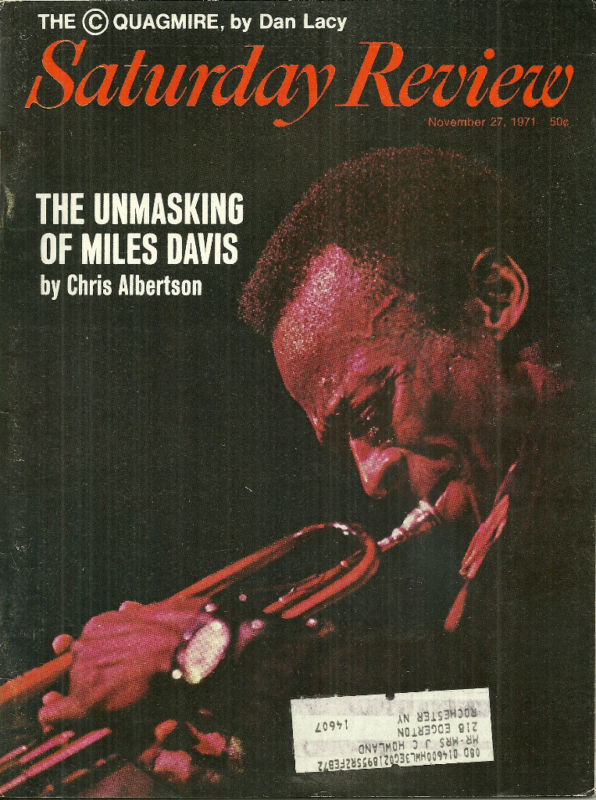 When Miles Davis returns from a six week tour of Europe and takes his quintet into Philharmonic Hall this week, chances are that a good percentage of his audience will consist of young black people. This is not a writer's prediction based on a typical Miles Davis following—no one has determined just what that might be—but a request Miles made in a phone call from Paris four weeks ago: Jack Whittemore, his agent, was to take half of Miles’ fee, purchase tickets for the concert, and hand them out to young black people who otherwise could not afford to attend. “Miles has never done anything like this before, but nothing he does surprises me,” says Whittemore, admitting that he doesn’t quite know how to go about distributing over $2,000 worth of free tickets to the right people.
 Such unusual gestures are as typical of Miles as they are atypical of most performing artists; they come as a surprise only to those who know the enigmatic trumpet player from a distance. Since his first appearance on the music scene some twenty-six years ago, Miles Davis has ben the subject of controversy; endearing with his music, offending with his personality. That is to say, his personality as it is most commonly interpreted, for the forbidding mask of hostility that in many minds characterizes Miles is just that: an image fostered by his own, deliberate lack of showmanship, and sculptured by reporters who have failed to recognize a serious artist at work. We don’t, after all, expect Rostropovich or Casadesus to warm up their audiences with small talk, and Miles Davis is as serious about his music as were Brahms and Schubert.
The music performed by Miles Davis today has undeniably evolved from that labeled “jazz,” which New Orleans pioneers played sixty years ago, but there are other elements contained in it, too, and if Miles’ music is jazz, then so is Stravinsky’s Ragtime for Twelve Instruments. He himself feels that jazz is “a white man’s word” whose application to his music is tantamount to calling a black person “nigger.” Accordingly, though he still must give performances in noisy, Smoke-filled night clubs, Miles approaches his work with the dignity it deserves.
During club or concert appearances, he never addresses his audience nor announces his selections, generally wears clothing that reflect future fashion trends—Gentleman’s Quarterly named him, “Best Dressed Man” ten years ago—saunters off the band stand or to the rear of the stage when not playing, and occasionally turns his back to the audience while focusing attention on his fellow musicians. “I have been with him on several occasions when he left the stage during a performance,” says Robert Altshuler, Columbia Records’ publicity director, “he either crouches or ambles to the side of the audience and you realize that he is deeply concentrating on everything that his musicians are playing—he is digging his own band, digging it in a the way a Miles Davis fan would. He simply becomes a part of his own audience.”
Club owners and concert promoters have been known to go into a rage over Miles’ seeming detachment, but conformity is not in his vocabulary and, despite the constant criticism, he has for twenty years remained the dark, brooding, wandering loner who doesn’t care whether he is regarded as an eccentric genius or a bellicose bastard, is long as people listen to what he says through his music.
The son of a well-to-do dental surgeon, Miles Davis has never been poor, but money cannot cure the inherent stigma that society has attached to people of dark skin and, faced with prejudices that sometimes are so subtle that only their victims can detect them, he has always sought to fight back on his own. “I am not a Black Panther or nothing like that,” he explains, “I don’t need to be, but I was raised to think like they do and people sometimes think I’m difficult, because I always say what’s on my mind, and they can’t always see what I see.”
One thing Miles never fails to see is someone taking advantage of him. “Back in the days when he was only getting a thousand dollars for a concert, Miles was booked into Town Hall,” recalls Jack Whittemore. “The tickets were selling very well, so the promoter suggested doing two shows instead of one. As was customary in such cases, Miles was to get half fee, five hundred dollars, for the second concert, but when I approached him with this he looked puzzled. ’You mean I go on stage,’ he said, ‘pick up my horn, play a concert, and get a thousand dollars. Then they empty the hall, fill it again, I pick up my horn again, play the same thing, and get only five hundred?—I don’t understand it.’ I told him that this was how it was normally done, but he was not satisfied. Finally, he tirned to me and said he’s do it for five hundred dollars if they would rope off half the hall and only sell half the tickets. When the promoters heard this, they decided to give him another thousand for the second concert.”
If Miles is “difficult,” it is because his honesty and candor are such rare traits in the show business world that few people know how to deal with him. His monumental disdain for the complimentary small talk and instant familiarity that entertainers are exposed to, and his absolute refusal to indulge in such trivia, has earned him the reputation of being unapproachable. “I have found,” observes Altshuler, “that when Miles meets someone new—people from the press I’ve introduced him to—he will check them out first. They don’t always know this, but Miles is actually laying down the ground rules for a totally honest exchange of questions and answers, and he will accept his interviewer only if he can be sure that his time is not going to be wasted with inane questions.” As one might expect, Miles is reluctant to appear on TV talk shows.
“Dick Cavett and Johnny Carson don’t know what to say to anybody black, unless there’s some black bitch on the show and she’s all over them,” he told me while conducting a guided tour of his unconventional but comfortable Upper West Side residence. “It’s so awkward for them, because they know all the white facial expressions, but they’re not hip to black expressions, and God knows they’re not hip to Chinese expressions. You see, they’ve seen all the white expressions, like fear, sex, revenge. White actors imitate other white actors when they express emotions, but they don’t know how black people react. Dick Cavett is quiet now when a black cat is talking to him, because he doesn’t know if the expression on his face means ‘I’m going to kick your ass,’ or if ‘right on’ means he’s going to throw a right hand punch. So,” he continued, pointing out the oddly shaped, multi-level blue tile bathtub, “rather than embarrass them and myself, I just play on those shows and tell them not to say anything to me—I have nothing to say to them anyway.”
Miles makes a good point, intelligent, relevant questions are rarely directed at black guests on TV’s talk shows, and the media’s handful of established hosts relate to his music about as well as Nixon’s “silent majority” relates to the problems of Bedford-Stuyvesant residents. We stepped down into the circular bedroom where a television set, dwarfed by a gigantic bed, silently radiated an afternoon ballgame. “I just put it on because I have nothing to do,” volunteered Miles as he waved his hand towards a long row of flamboyant clothes and boots in dazzling colors. “I have these made for me.” When CBS flashed the image of its night host on the little screen, it served as a cue for Miles. “Merv Griffin is embarrassing to me,” he said. “I felt like yanking his arm off last year.” He was referring to the 1970 Grammy Awards ceremony at Alice Tully Hall, during which, after a superb performance by Miles’ group, Griffin—the evening’s master of ceremonies—brushed him off with a remark that was disrespectful of his music. “The trouble with those cats,” said Miles, “is that they all try to come off to those middle-aged white bitches.”
Such remarks don’t exactly produce invitations to guest on late night TV shows, but Miles aims his fire without such considerations. Even Columbia Records—with whom he has enjoyed a good and fruitful relationship since the mid-Fifties—has been victimized by his public candor. In a recent statement, published by a black weekly, Miles—who refers to himself as the “company nigger”—suggested that his label was not affording black artists equal opportunities in terms of exposure. As we seated ourselves comfortably in the round sunken living room, I asked if there had been any repercussions from Columbia. “No,” he replied, “Clive [Davis, Columbia’s president] asked me why I had said that, and I said ‘Was I telling a lie, Clive? If you can say I’m a liar, I’ll retract that statement.’ You see, all those records I have made with them have been a bitch, and they come out being rich behind all this token shit.”
“You would think that he’s not grateful,” says Clive Davis, “but I just know he is. I’m not sure that it’s his mind that he speaks; I’m not sure that he just doesn’t tell people what they want to hear, because it takes a certain amount of research before you go off making such statements. I’m prepared for all of Miles’ statements, none surprise me. I do mentally treat him differently, not because he’s black—because we have such a tremendous number of black artists—but because he’s unique among people, and you expect the unexpected from Miles Davis.”
Clive Davis admits that he is not totally unaffected by Miles’ criticism. “It bothers me because I think we have really done a tremendous amount to be creative along with him, and we work very closely with him so that we make sure that he sells not only to jazz audiences and to contemporary rock audiences, but to r&b audiences as well.”
.jpg)
Despite his complaints, Miles readily admits to having an unusually close relationship with Columbia, which is borne out by his long tenure with the label, and the fact that the 45-year-old superstar of black music could easily find another home for his recording activities. “The Internal Revenue Service is always after me,” he says, “but I just send their bills on to Clive. I got one for $39,000, but he took care of it.” When asked to verify this, Davis gave a diplomatic reply: “Miles is treated very well by Columbia Records,” he says. “I think he’s really appreciative of it, too—we don’t get Internal Revenue bills from Chicago or Blood, Sweat & Tears.”
The recent upsurge in Miles Davis’ popularity is mainly due to an album entitled “Bitches Brew.” Released in the spring of 1970, it was the subject of a well coordinated national promotion campaign aimed more at the young rock fan than at the established Miles Davis follower. Of the close to thirty Miles Davis albums that have accumulated in Columbia’s catalogue over the past fifteen years, “Porgy and Bess”—with sales figures approaching 100,000—had been the most successful; other albums have averaged around 50,000 and recent releases have barely crawled to the 25,000 mark, but “Bitches Brew”—a two-record set—-has sold over 400,000 copies in this country alone.
The wide stylistic gap that separates “Porgy and Bess” and “Bitches Brew” is reflected in the sales figures, but it is not just the sound of his music that Miles has changed, for he has also updated the group’s appearance. Surrounded by a young inter-racial group of musicians sporting afros, long hair, headbands, dungarees and dashikis, Miles has transformed himself into a trendy, youthful figure. With his flared pants, leather boots, tasseled Western vest and love beads, he points his shiny horn downward and roams slowly amid the complex-looking electronic equipment. It is no coincidence that the current Miles Davis band has the look of a modern-day rock group—he is determined to win over a new generation of fans, and judging by album sales, the plan is working. Miles’ new music is an abstraction of everything he has played before; it is as if he were summing it all up for us, but we know that he won’t let it end here—this is merely the latest plateau. At the same time, it is a testimony to Miles’ artistry and forward thinking that none of his past recordings—going back to his revolutionary 1949 Capitol sessions—sound outdated in 1971.
If rock groups are not envious of Miles’ musical accomplishments, they perhaps should be, for many of them have yet to approach the stage of development reached by Miles and collaborator Gil Evans in the Fifties. One can’t help, but wonder if, ten or twelve years from now, anyone will have more than a nostalgic nod for the current efforts of today’s musical pop heroes. There is bitter irony in the fact that Miles has to take second billing—as he did last year—to a group like Blood, Sweat and Tears, which sells records in the millions and turns youthful audiences into a frenzy of excitement with musical ideas borrowed from Miles’ past. “I can’t be bothered with these groups,” says Miles, recalling with some amusement how he turned down promoter Bill Graham’s request that he retract a negative statement about Blood, Sweat and Tears, “if they can’t stand constructive criticism, to hell with them. I’m honest in what I say, I don’t lie, so I don’t have to watch my words or take them back.’
There are those who feel that Miles’ attacks on rock groups are unfair and that he, in an odd sense, owes these performers a debt of gratitude. They see his appearances last year at the Fillmores East and West—Meccas for the rock cult—as a turning point in his career, but they seem to lose sight of the fact that these concerts, along with Columbia’s promotional efforts, would not have sold the public on Miles Davis if he had not had something substantial to offer. For over twenty years, Miles has pointed music in new directions, reaching unexplored plateaus, then forging ahead before others could catch up with him. “He has never been bound by convention,” says Teo Macero, who has produced virtually all of Miles’ recordings since 1958. “You wouldn’t expect Miles to go back and do something the way he did it years ago anymore than you would expect Picasso to go back to what he was doing in his ’blue’ or ’rose’ periods.”
One tangible result of Miles’ recent commercial success his been the signing up by Columbia of several black musicians who last year would hardly have been able to get as far as Clive Davis’ eleventh floor office. Explaining this change in policy, Clive Davis makes one momentarily forget that he is running a highly competitive commercial business: “I am very eager to allow Columbia to be used by the most forward looking American jazz artists, to explore what kind of synergy can come out of jazz and rock. What do the jazz giants, the leading jazz figures of today have to say? What is their reaction to the fact that, in attempting to fuse jazz and rock, Chicago and Blood, Sweat and Tears have reached millions of people all over the world while they, without such an attempt, only reach a few thousand with their music.” He mentioned that the label has signed Omette Coleman, Jack De Johnette, and Weather Report—an offshoot of Miles’ group—and that it was recording Charles Mingus. “Just as Columbia sponsored a Modern American Composer series in classical music—not having any less reverence for Stravinsky, Mahler, or classical music performed by the New York Philharmonic or the Philadelphia Orchestra—so we are here exploring a very exciting now development in music, to see where it will go. I don’t know where it will go, but I think that by opening up the company to this kind of exploration of music by brilliant talent, we are providing a tremendous service.”
 Columbia’s aims are obvious and Miles is not fooled for a minute: “It’s smart to be with the niggers sometimes. I know what made “Bitches Brew,” but they need guidance: Mingus needs guidance; Omette needs guidance; nobody’s going to tell them what to do because then they might call them white bastards. They have to tell Mingus what to do, otherwise he’ll do the same shit all over again, and they have to tell Omette that he can not play the trumpet and violin. Motown shows you where it’s at, man.”
It is difficult to imagine anyone telling Miles Davis what to do with his music, but he is just as receptive to constructive criticism as he is ready to give it. “Miles lets you be as creative as you want to be,” says producer Teo Macero, “as long as it doesn’t screw up his music. A lot of artists say ’Man, don’t touch my music, don’t do this, I don’t want any electronic sound, don’t use a Fender bass, and so forth, but Miles is so far ahead that he’s on the same wavelength as you are, which makes for a great deal of excitement. When he plays, he does it with such intensity that every note is a gem. He doesn’t make any mistakes, if he doesn’t like something he did, it is usually because it didn’t capture the right feeling. We never discuss the music or how things went in front of anybody else; he either calls me out into the hall or we sort of talk in the comer, and I try to refrain from talking about the piece over the studio talk-back system. That’s something I’ve learned by working with him over the years. Like his private life, he keeps it to himself; I never ask, because if he wants to tell me something, he’ll do it.”
The physical aspects of producing a Miles Davis album are as unconventional as his music. As Macero explains, there are no takes one, two or three, “because there’s something new that pops into the music every time, whether it’s deliberate or just by accident—no one seems to know quite for sure. The group is constantly building toward a final goal and we don’t stop the tape machines like we used to do in the old days—they run until the group stops playing. Then we go back, listen, and decide between us what should be tacked to what—it becomes a search and find routine, and finally it’s all there, it’s just a matter of putting it all together. There are a lot of tapes for each album, but we may use only the material from two or three sessions.”
Two albums, “Miles Davis at Fillmore” and the sound track for the documentary film “Jack Johnson,” have been released since “Bitches Brew,” but neither shows signs of doing as well commercially. This of course provides an incentive to make the next release particularly interesting, and it looks as if “Live and Evil” (one word is the reverse spelling of the other) will be just that. Scheduled for a December release, it is the distillation of ten to fifteen reels of tape, selected from an original working pile of thirty reels. “The album is partly live, and it has an ethereal evil, where the mind is clouded and all these things are happening,” says Macero, “it’s like a wild dream.” Artist Mati Klarwein, who was responsible for the unusual “Bitches Brew” cover, has been commissioned to give the new album a similar look.
If “Live and Evil” becomes another “Bitches Brew,” there will undoubtedly be more demands on Miles Davis’ time, a commodity he values and likes to spend as a part-time pugilist working out in a midtown gym, swimming in some appropriate waters, sleeping in his oversized bed, or simply relaxing with friends amid the international decor of what has been termed “an architect’s nightmare”—his house on West 77th Street.
Unimpressed by critics (“I don’t know any, because I never read what they say”) and disc jockeys (“If we didn’t make any records, they wouldn’t have anything to do”), Miles periodically threatens to quit the music business to avoid the exploitation which he admits is “the name of the game.” Some day, he will undoubtedly do just that, and then a smile the public never knew may emerge from behind the mask.
A footnote: Click here to hear the 1970 phone interview I had with Teo Macero in preparation for the above article.
A footnote: Click here to hear the 1970 phone interview I had with Teo Macero in preparation for the above article.
Subscribe to:
Posts (Atom)
